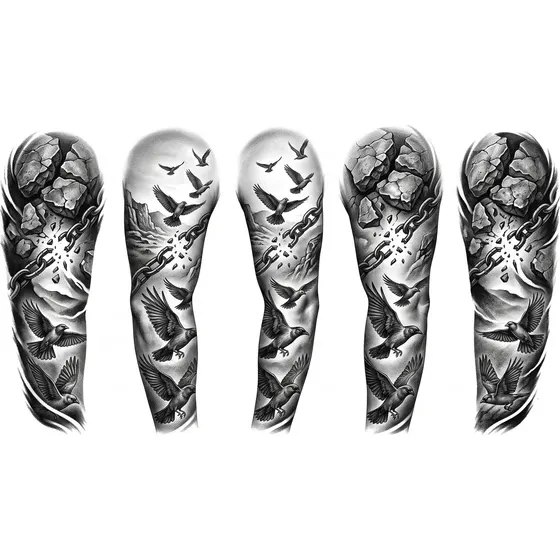
“A full sleeve of black and grey realism: cracked stone, breaking chains and birds in flight”
Generate this
Collection
A sleeve is one composition that wraps a cylinder—not a scrapbook of unconnected tattoos. You need a path for the eye from every angle: heroes at the shoulder or outer bicep, quieter connectors on the inner arm, and backgrounds that stitch sessions together over months.
“A full sleeve of black and grey realism: cracked stone, breaking chains and birds in flight”
Generate this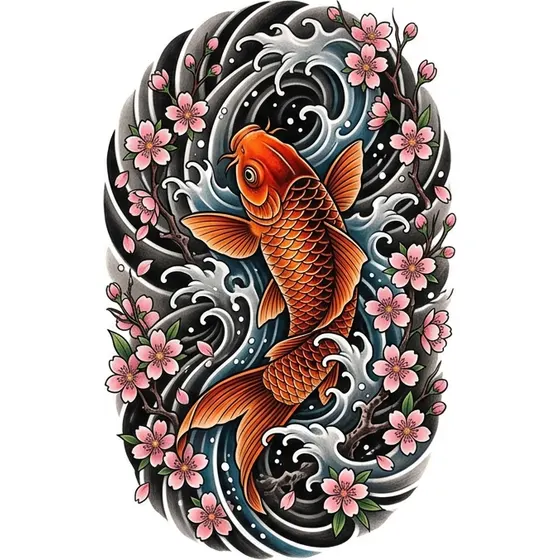
“A Japanese half sleeve with koi, waves and cherry blossom”
Generate this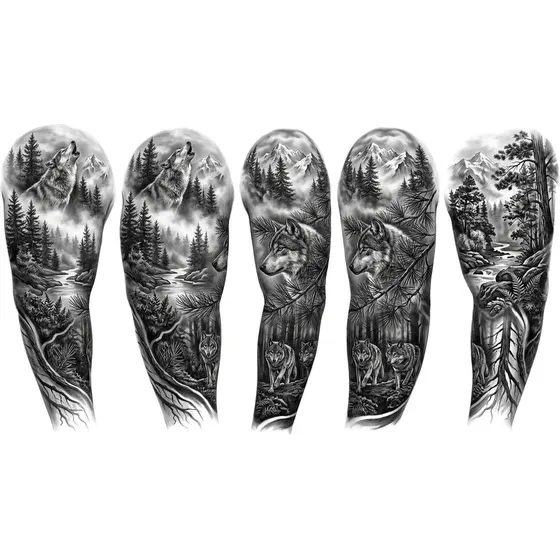
“A forest sleeve with wolves, pines and mist from shoulder to wrist”
Generate this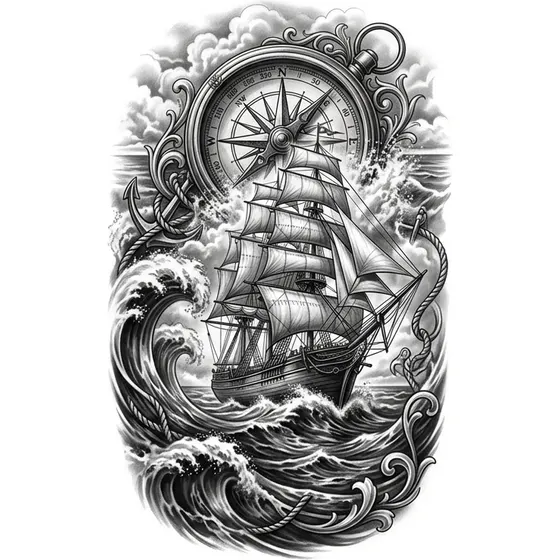
“A nautical sleeve with a ship, compass and rolling waves”
Generate this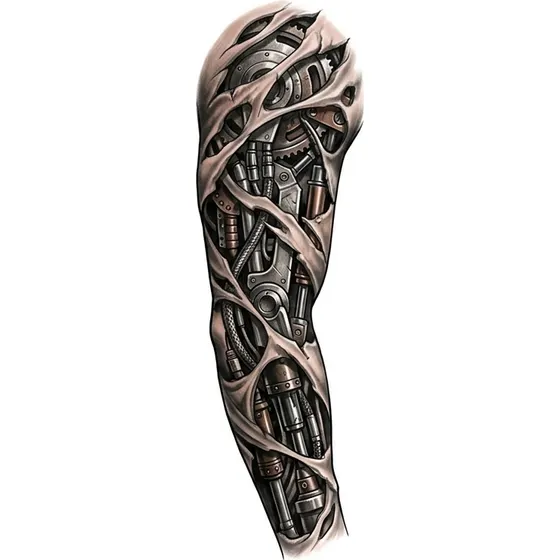
“A biomechanical sleeve with structure showing beneath torn skin”
Generate this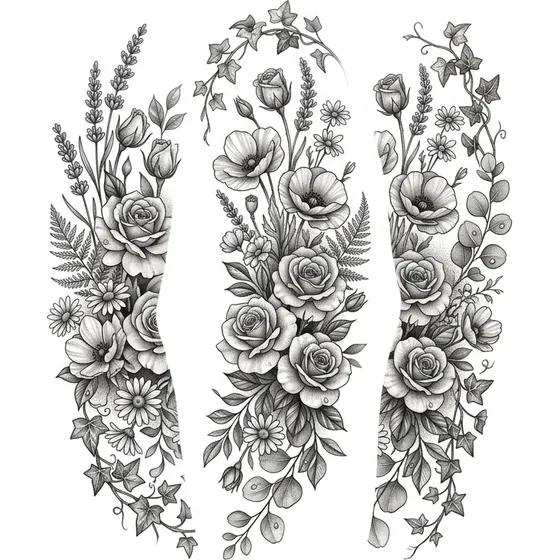
“A botanical sleeve of layered wildflowers and trailing foliage”
Generate thisHalf sleeve usually means shoulder through elbow—enough canvas for a story beat, still coverable with a short sleeve, and easier to schedule. Full sleeve continues to the wrist. It needs mid-arm transition and a wrist landing so the piece does not die at the elbow crease.
Decide early: a closed half finished at the elbow (clean edge, ornamental cuff, or soft fade); an open half with unfinished edges that invite a later full-sleeve extension; or full from day one—generate the whole arm narrative even if you only tattoo the upper half first.
Say the horizon in the prompt (“half sleeve ending at elbow,” “full sleeve to wrist,” “leaves room to extend”) or the model invents a random crop.
Pick one glue before you pile on subjects. Shared background weather—waves, mist, smoke, wind bars behind every hero—fits Japanese and realism. A value spine of dark anchors keeps mid-greys from turning to mud (blackwork, B&G realism). A motif family keeps one ecosystem—forest, nautical, botanical. Biomechanical wrap uses continuous under-the-skin structure. Negative-space channels leave bare paths for elbows, inner arm, and future add-ons.
Random flash stamps on one arm are not a sleeve. If you already have separate pieces, generate a connector (smoke, waves, vines) and ask whether those gaps can unify—or whether a cover-up redesign is smarter.
Strong fit: a wearable narrative across months of sessions; one primary theme (wildlife, Japanese flow, nautical, forest, botanical, biomechanical); realistic expectations for elbows, armpits, and inner biceps; budget and healing time between sessions.
Stalls without a rethink: unrelated icons with no background plan; portraits stacked edge-to-edge with no breathing room; treating a flat AI preview as a finished wrap stencil; starting at the wrist with no shoulder plan (usually reverse that order).
Think in bands: shoulder (often the hero), outer mid-arm (continuation), inner arm (quieter texture or negative space), elbow (flexible—avoid fragile micro-detail as the only focal), forearm to wrist (landing motif or runoff).
Growth over sessions: generate a master for the whole arm, then crop session 1 (shoulder–elbow) for the appointment. Keep the master so session 2 matches weather and motion. Mention “consistent background” or “continuous wave pattern” when regenerating variants.
Japanese-led sleeves: deepen grammar on Japanese tattoos. Heavy B&G wildlife: compare tattoo ideas for men and realism tattoos.
Open generate.tattoo. Pick a style that matches your cohesion system (Japanese, Realism, Blackwork, Neo-Traditional…). Prompt theme + half/full + wrap + background glue (“shoulder to wrist,” “mist connecting wolves”). Lock the hero, then regenerate only weather or the forearm landing.
Optional Pro body preview for cylinder wrap on your arm photo. Bring master + session crop to your artist. See pricing; browse the gallery and back tattoo ideas if the story may spill onto the torso.
These are starting points. Change the subject, the placement or the size — the generator will follow whatever you write.
Start from scratch